
HOCHDEUTSCH VS. SCHWEIZERDEUTSCH
Today’s blog comes to you from The Seven Alpina Boutique Hotel in Klosters, Switzerland.
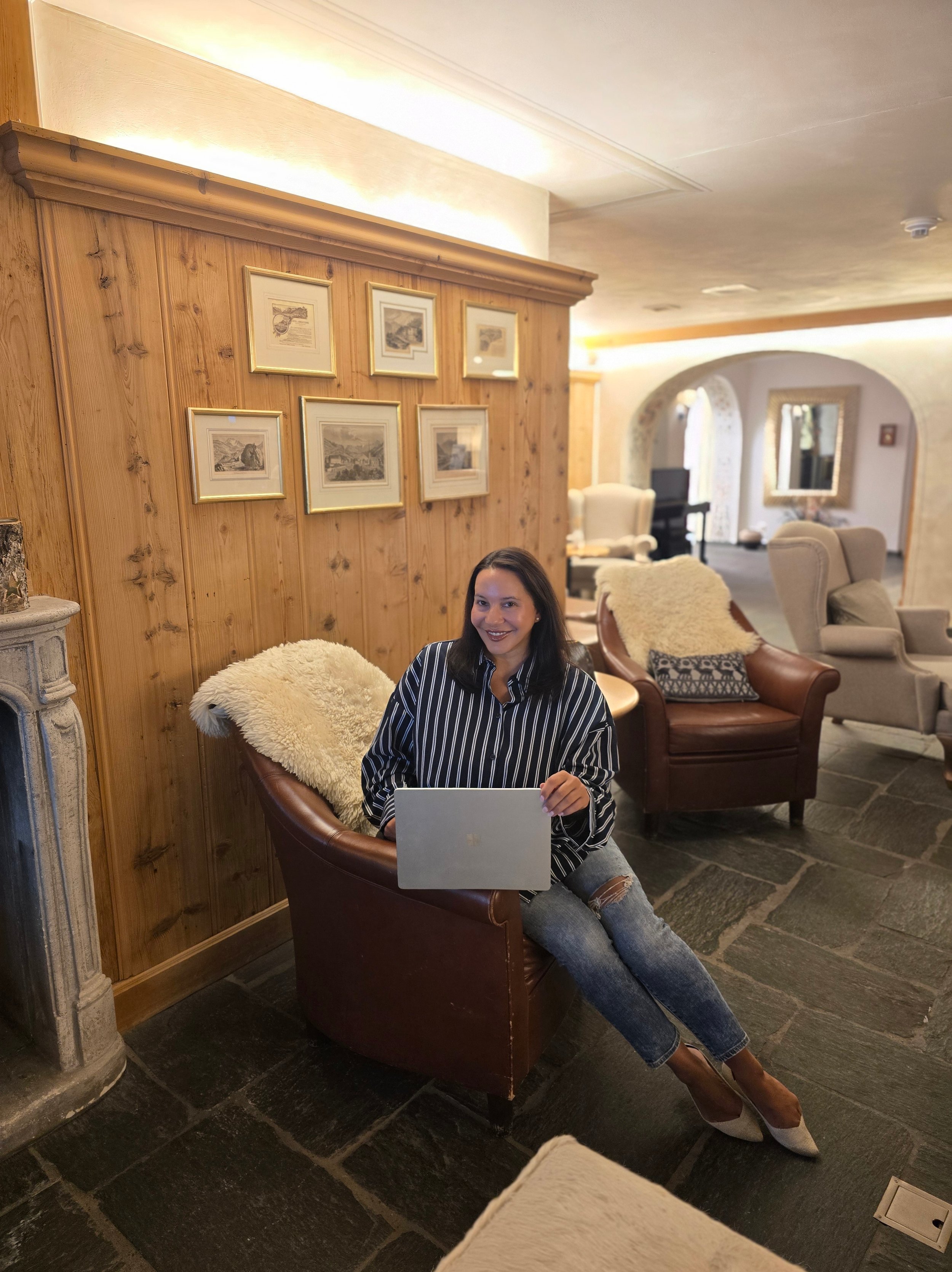
Surrounded by the Swiss Alps, it felt like the perfect scenery to touch on a very Swiss subject:
Hochdeutsch vs. Schweizerdeutsch
Which one should you actually learn when you live in Switzerland? Which one should you learn if you live in Switzerland?
You move to Switzerland. You start learning German. You finally feel ready to use it in real life.
And then someone speaks to you in Swiss German.
Suddenly, the German you learned in class sounds very different from the German you hear at the bakery, on the tram or over coffee.
Welcome to Switzerland.
The question I hear from expats all the time is: Should I learn Hochdeutsch or Schweizerdeutsch?
The answer? Ideally, both. But not necessarily at the same time.
START WITH HOCHDEUTSCH
Hochdeutsch, or Standard German, gives you the foundation.
It is the German you learn in textbooks, use for writing and encounter in more formal situations. It gives you the grammar, vocabulary and structure you need to build confidence in the language.
If you are starting from zero, this is where I would begin.
Think of Hochdeutsch as your base.
Once that foundation becomes stronger, understanding Swiss German becomes much easier.
BUT SWITZERLAND SOUNDS DIFFERENT
Then comes Schweizerdeutsch.
Swiss German is what you will hear constantly in everyday life in German-speaking Switzerland.
At the café. At work. Between friends. On the street. In casual conversations.
And yes, at first, it can feel like an entirely different language.
Guten Morgen → Guete Morge
ein bisschen → es bitzli
klein → chli
Auf Wiedersehen → Uf Widerluege
The exact words and pronunciation can vary depending on the region, but that is part of what makes Swiss German so interesting.
GERMAN FOR REAL LIFE
For me, language learning should never exist only inside a textbook.
If you live in Switzerland, you need German for your actual life.
Ordering coffee. Talking to your neighbors. Understanding conversations around you. Going to appointments. Communicating at work. Speaking with teachers at your child’s school.
That is why my lessons are personalized around the situations you actually encounter.
Because knowing a grammar rule is useful.
Knowing what someone just said to you is even better.
DO YOU NEED TO SPEAK SWISS GERMAN?
Not necessarily.
You can speak Hochdeutsch in Switzerland and be understood. But learning to understand Swiss German can make a huge difference in how connected you feel to everyday life here.
You do not have to wake up tomorrow sounding like you were born in Zürich.
Start with understanding.
Learn the expressions you hear around you.
Get comfortable with the rhythm and pronunciation.
And gradually, Switzerland starts sounding a little less foreign.
SO, WHICH ONE SHOULD YOU LEARN?
If you are a beginner: Start with Hochdeutsch.
If you already speak German and live in Switzerland:
Start adding Swiss German listening, vocabulary and everyday expressions.
The goal does not have to be perfect German.
The goal is to feel confident enough to participate in the life happening around you.
DON’T JUST LIVE HERE. UNDERSTAND HERE
At Csilla Language Lab, I offer personalized German lessons for expats, professionals and international families in Switzerland.
From Hochdeutsch to everyday Swiss German, lessons are built around your level, your life and your goals.
